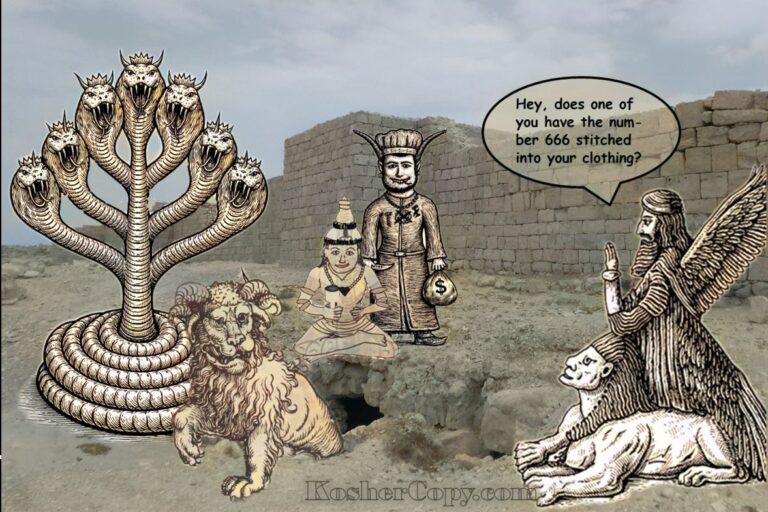
Who is the Beast of Revelation?
In this blog, during the week of Presidents’ Day, we will look at the political situation as described in the Book of Revelation. This blog will focus on three (and maybe a fourth) prominent political groups included in the pages of the Apocalypse. The names of these groups, The Dragon, The Beast, and the False Prophet, are familiar to readers; however, speculative writers and speakers have hijacked the real identity of the individuals in these groups.
In my book, John’s Apocalypse: A Jewish Idea, I explain how I read the book of Revelation through a different lens. I think John the Elder wrote about recently transpired past events rather than distant future speculations. John, as a prophet of God, was attempting to understand for himself and to explain to others why the world had changed, or ended. The Apostle was in exile; his homeland lay in ruins, Rome demolished the Temple, and rebels eliminated the Priesthood.
Was the Beast a political official?
Galilean and Judean politics of the first century dominate the central section of the Apocalypse (which interpreted means the unveiling). The Dragon, the Beast, and the False Prophet represent positions filled with real people. Since the book of Revelation tells a story that progresses through time, the names of individuals in the political office change, but the official position does not change. (Every four to eight years the name of the President changes; the name of the office does not).
When John writes about “The Beast” (by this I mean the office held by the first Beast of Revelation 13; the second beast of the same chapter is called the “False Prophet” to avoid confusion.) In terms of personality, political corruption, power plays and real deeds, officials holding the office of “The Beast” and “The False Prophet” can all truly be called beasts.
The Beast was a political office held by many people in the story of Revelation. The Beast was the ruler and could be called the Governor, King, Tetrarch, Ethnarch, or Oligarch. Beasts mentioned in the last half of the Apocalypse are all descendants of one family.
How did the Beast come to power?
The power of the Beast extends to ancient times (a topic I explore in my book). To easily understand the Apocalypse, however, the answer to this question begins with Rome’s entrance into Galilee and Judea. Rome entered the Holy Land to settle a dispute between two descendants of the Maccabees, one serving as King and the other as Priest. When Rome entered a country, it became its possession. (In like manner, current commentary on Revelation is obsessed with Rome, not little local Israel).
Because the generational political and religious leaders of the Holy Land were the problem, Roman military officials looked elsewhere to find a competent governor. They did not have to look far, because one man, Antipater the Idumaean, had come to their aid militarily.
Antipater was a businessman with a ranch that traded regionally, and therefore he had connections. Among this man’s products were doves, which had dietary and ceremonial uses. He might have raised homing pigeons as well in his dovecote, which is now an Israeli National Park.
Antipater used his farm labor and servants and his political connections to further the pursuits of Roman general Pompey. Antipater the businessman was rewarded well with the political position of chief minister of Judea with the right to collect taxes. His sons, Phasaelus and Herod, became governors of Jerusalem and Galilee.

Why did John call these officials “The Beast”?
The Beast was an appropriate term for Herod the Great and his descendants. King Herod was famous for killing Galilean rebels, the Jewish Sanhedrin, family members, and for attempting to kill Jesus. In my book “Israel: Stories for your Journey,” I write a story about how he probably took great joy in entering his father’s dovecotes when a teenager and killing the doves.
The story of the rise and fall of Antipater the Idumaean and his descendants paints a very real picture of politics. Many individuals begin their journey into this corrupt and convoluted field to do good and improve their communities. To accomplish community objectives, these local officials discover the power of government (to levy taxes and pass laws). If these community servants are successful, they advance into state and national politics. When a person lands in a state or national position of power, the needy, owners of small and large businesses, wealthy people who desire more money, and power brokers come for help with propositions. The onetime community leader begins to enjoy this new power and uses it for personal advancement. Power corrupts, and absolute power corrupts absolutely.

Who were the seven heads and ten horns?
Often commentaries and teachers list the names of ten Roman emperors as the ten heads. This is co-opting the text of Revelation. The apostle John (like Flavius Josephus) was a Galilean who knew regional politics with all of its gossip. While John references the Roman Caesars in Revelation 17 (because a daughter of one Beast, who was a beast herself, has a fling with an Emperor… a matter of Galilean gossip).
Beasts appear in Revelation 11:7; 13:1-5; 13:11-18; 14:9-11; 15:2; 16:2, 10, 13; 17:3, 7-17; 18:2; 19:19-20; 20:4, 10. The first Beast, Herod Antipas, killed Jesus and John the Baptist. Another Beast, Herod Agrippa I, killed James the Apostle (brother of John). A third pair of Beasts, Herod Agrippa II and Bernice, presided over the trial of Paul in Cesarea, ruled when the High Priest ordered the execution of James the brother of Jesus, and they were present with Roman General Titus when Roman General Titus destroyed the Temple. Herod the Great attempted to kill Jesus as an infant.
How does this relate to the book of Revelation?
There is much more to know about the Beast, the Dragon, and the False Prophet than I can put into a few blogs, so I wrote a book. The book contains many more details, including the story leading up to the appearance of the Beast, the destruction of the Temple, and the aftermath.
The book connects every part of the story so that the reader can understand the whole story. It tells the reason things happened the way they did. The book also contains many eyewitness statements, charts, references and pictures so readers can check the facts. The book will reveal the meaning and structure of the Apocalypse so people can understand John’s message.
What does this mean for today?
John wrote the details and message of the Apocalypse so God’s servants would know what must soon take place. (Rv 1:1) Although John wrote, “the time is near,” (Rv 1:2) The Revelation of Jesus Christ has a message for readers today; and it is not about how the world will end; but how we shall live. The book is amazing as its pattern appears.
I have written these blogs and my book to clear up misconceptions about the message of the Book of Revelation. If you enjoyed this blog, please share it with others.