
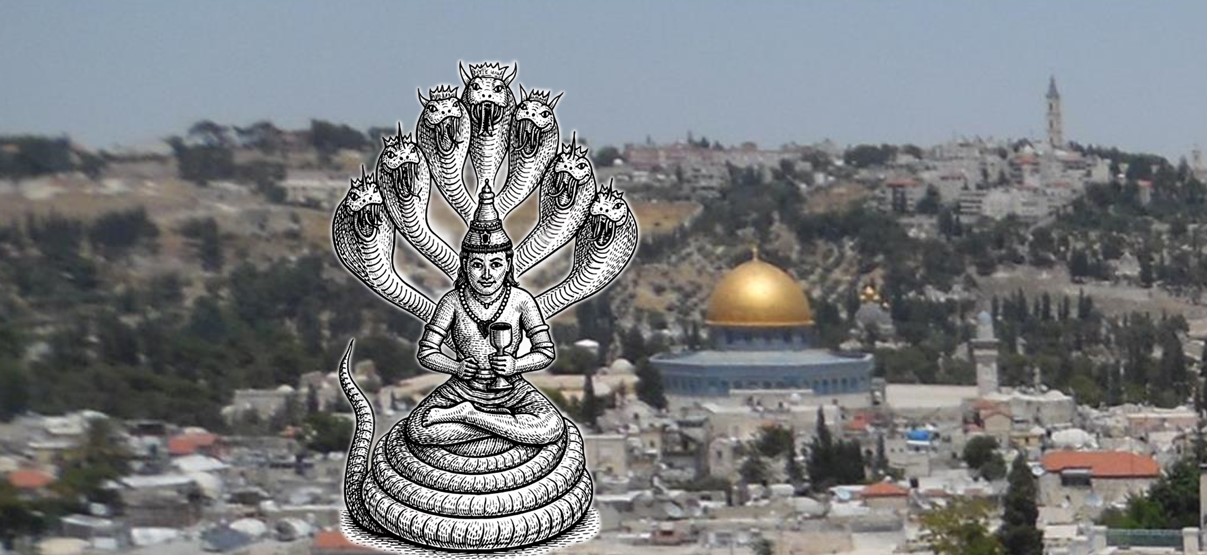
What are the 4 Riddles of Revelation 17?
Throughout most of history people have used riddles as questions ot make others think. As in the art of writing poetry, there is skill needed in designing riddles so so they seem to be trick questions, but have an actual answer. The Bible features riddles that clouded opponents’ ability to answer and prevent the faint at heart, who weren’t truly listening, from grasping the actual question.
Several famous biblical riddles include Samson’s riddle (Judges 14:12-20), The Queen of Sheba’s hard questions (1 Kings 10:1-9), Ezekiel’s riddle (Ezekiel 17:1-10), Proverb’s questions (Proverbs 1:6), and riddles posed by John in the book of Revelation. Revelation 17 poses four riddles that challenge the reader to find “the mystery of the woman, and of the beast with seven heads and ten horns that carries her.” The riddles in this chapter connect to pictures presented during John’s visit to heaven, the mirror to this chiasmus.
My book, “John’s Apocalypse: A Jewish Idea” gives details to all of this with footnotes. Revelation 17 stands amid the narrative John is presenting on the destruction of Jerusalem. To fully understand the Book of Revelation, I highly recommend purchasing a copy of this book to read and use as a resource. (If you are close to a library, I would recommend asking the library to purchase a copy to provide a reference for others).

Riddle #1: Who is the Beast?
John states Riddle #1 as a statement: “The beast, which you saw, once was, now is not, and yet will come up out of the Abyss and go to its destruction. The inhabitants of the earth whose names have not been written in the book of life from the creation of the world will be astonished when they see the beast, because it once was, now is not, and yet will come.” (17:8)
The starting point in understanding the riddle is to see its connection to earlier scripture found in the chiasmus on the scene observed by John in heaven. In Revelation 4:8 the angels sing, “Holy, holy, holy is the Lord God Almighty, who was, and is, and is to come.” The Four Living Creatures “give glory, honor and thanks to him who sits on the throne and who lives for ever and ever.” The point of this statement (found twice so you don’t miss it) is the difference between God in heaven and the Beast on earth.
The song builds the greatness of God and shows the deficiency in the beast. God and the beast have a past, each with a “once was.” They have a future, each “is to come.” But only God exists in the present, for the beast clearly “now is not.” And while God’s omnipresence substantiates eternity, the Bible tells us the beast “will come up,” and then will meet its end. (Rv 20:10, 14-15)
Where does the Beast rule?
“Who is the beast?” The beast continuously makes appearances in history (It is not eternal like God). The beast had a beginning, and in the end will face termination. Sometimes people can identify the beast in someone commonly known; but the beast is more than an individual because its spirit shows up in every generation. (Ex 17:16)
Consider his appearances in the Apocalypse. He came up out of the abyss with his flock of locusts. (Rv 9:1-2) He came up again (Rv 11:7) to attack and kill the two witnesses. Revelation 12:3 calls him an enormous red dragon, who attempted to attack the image of a woman, Israel, and her offspring. The eternal beast, never to be absent, shows up in Revelation 13, our current chapter, and other places.
The Beast is more than just a person; the Beast is an appearance of eternal power that some people, through selfish desire, allow to inhabit themselves. The evil overtly or covertly positions itself to resist good and God’s people.
Why is the Beast called Evil?
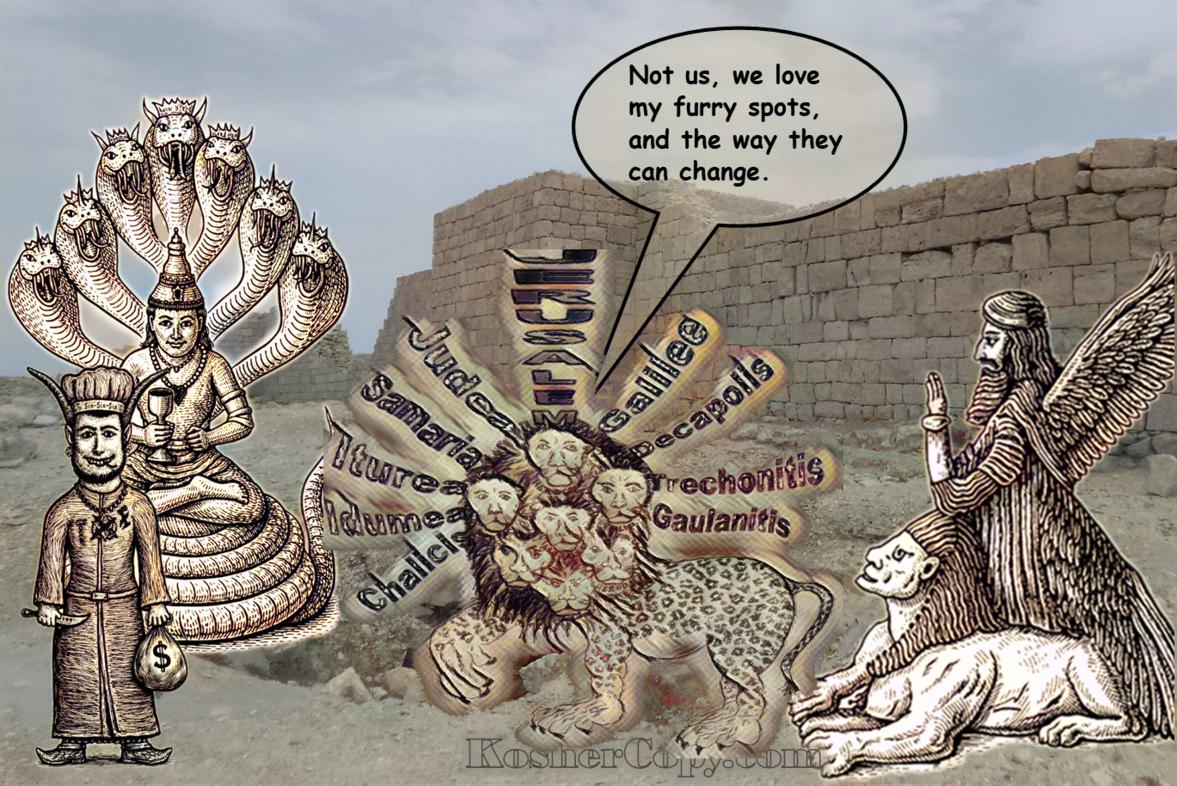
Sometimes, the personification of evil will overtake one person, taking up residence as an inhabitant and controlling the targeted individual with a corrupt spirit. This spirit controlled several figures described in the Apocalypse as Beasts with seven horns. (Rv 12:2; 17:3, 7, 9) Each of these represents a great person admired and respected by the general population (to dwellers on earth) who are ignorant of the way of God (whose names were not written in the book of life). The fame of these brutes will only help them on earth. Ultimately, the Dragon and beasts will face eternal destruction.
Is the Beast Amalek?
Sometimes the evil spirit overtakes an entire nation. The tribe of Amalek, which includes the house of Herod, exemplifies this evil people group. In the genealogy, Amalek was Esau’s grandson through a union of his son Eliphaz with a concubine named Timna. And while some would think Amalek’s birth marked his beginning, the Bible would prove them wrong because the evil spirit of Amalek appears even earlier. (Ge 14:7) The Amalekites gained fame when at the foot of Mt. Sinai, just before Moses met God to receive the covenant, this evil desert tribe attacked Israel in the worst way.
According to Jewish tradition, Amalek attacked older people, women, and children who straggled at the rear as Israel traveled towards Mount Sinai. Amalek attacked Israel in the time of the Judges, King David, Hezekiah, and as Haman in the story of Esther. In the manifestation revealed in the Apocalypse, Amalek inhabits the House of Herod. Although the Herodian family would lose their power during John’s time, Moses foretold that the spirit of Amalek would reappear in every generation when he said, “The LORD will be at war against the Amalekites from generation to generation.” (Ex 17:16)
Riddle #2: Who are the original 7 Kings?
In Riddle #2, The angel next challenges the listener by stating, “The seven heads are seven hills on which the woman sits. They are also seven kings. Five have fallen, one is, the other has not yet come; but when he does come, he must remain for only a little while. The beast who once was, and now is not, is an eighth king. He belongs to the seven and is going to his destruction.” (17: 9-11)
John, in a very distinct way, pairs “mind” and “wisdom” when he writes of the seven heads (like there is a brain up there!). The first couplet of this riddle probably shares the creation story of Rome. Important legends (including Virgil’s Aeneid) from this period tell the story of Romulus, a descendant of the kings of Troy, who founded the original city on Palatine Hill. Rome grew rapidly during the early formation period and incorporated cities on seven hills into a protective alliance. Pliny the Elder (23-79 CE) wrote that the walls of the seven cities on seven hills, built years prior, extended 13.4 Roman miles, “when the Vespasians were emperors.”
Who are the Seven Heads on Seven Hills of Rome?
The angel reveals each hill represents a “head,” which could mean the leader of the city that joined the alliance. It could also be argued that each of the seven hills of pagan Rome claimed one or more of the gods as its head.
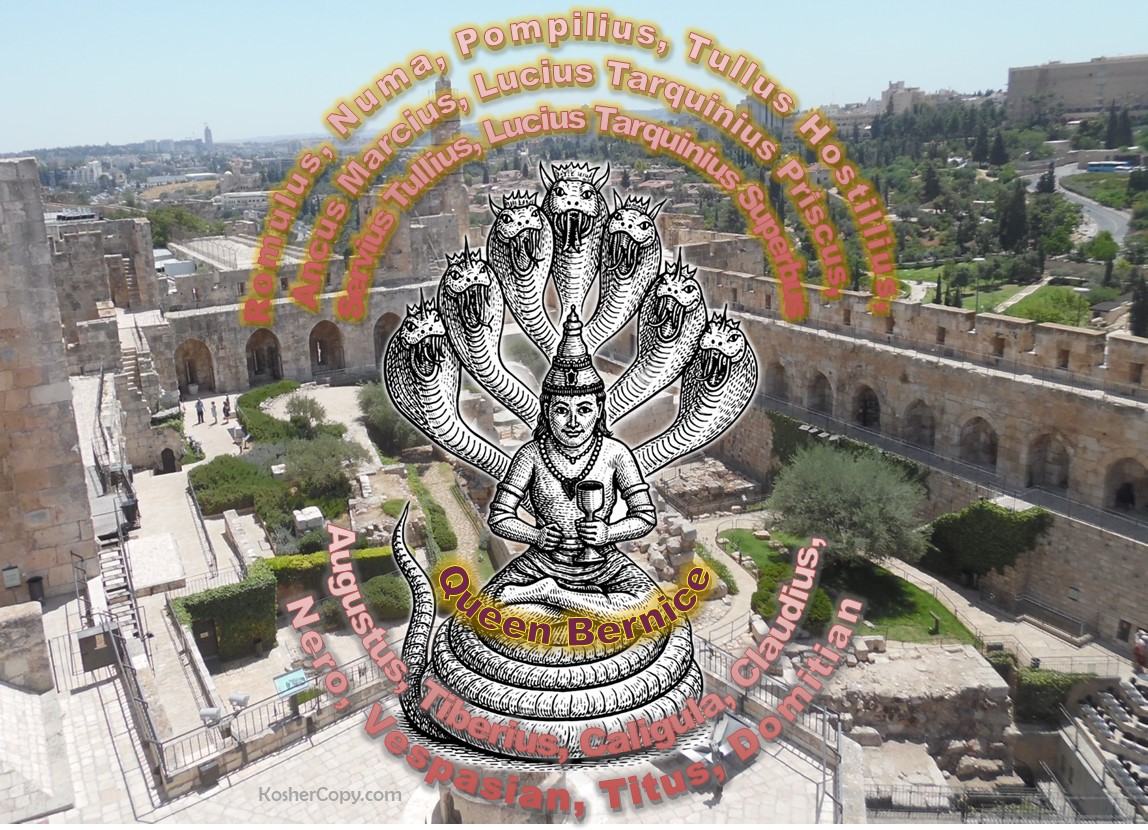
Probability, the text wants the reader to think about the first seven kings who ruled the city on the seven hills: Romulus, Numa Pompillius, Tullus Hostillius, Ancus Marcius, Lucius Tarquinius Priscus, Servius Tullius, and Lucius Tarquinius Superbus (and also an eighth, who is one of the seven, named Titus Tatius).
Where do you see a second set of Kings?
In the second couplet of the riddle verse, a new set of Roman emperors enters the passage. “also seven kings, five of whom have fallen, one is, the other has not yet come.” These are the Caesars of the Imperial Roman Empire.
The first imperial leader, Augustus Caesar (63 BCE–14 CE), adopted son of Julius Caesar, ruled the Roman Empire (27 BCE-14 CE), and therefore Galilee and Judea, at the time of Jesus’ birth. Julius Caesar claimed descent from the goddess Venus, and people deified him after his death. Augustus used the title “Divi Fillus (Son of the Divine) during his life, and they honored after his death as a god. During the time John wrote the Book of Revelation, temples to Augustus abounded in Asia Minor and the Roman Empire. Augustus Caesar wrote, a few months before his death, “I was triumvir for the settling of the state for ten continuous years. I was the first of the senate up to that day on which I wrote this, for forty years. I was high priest, augur, one of the fifteen for the performance of rites, one of the Seven of the sacred feasts, brother of Arvis, fellow of Titus, and Fetal.”
Who are the 7 Roman Rulers?
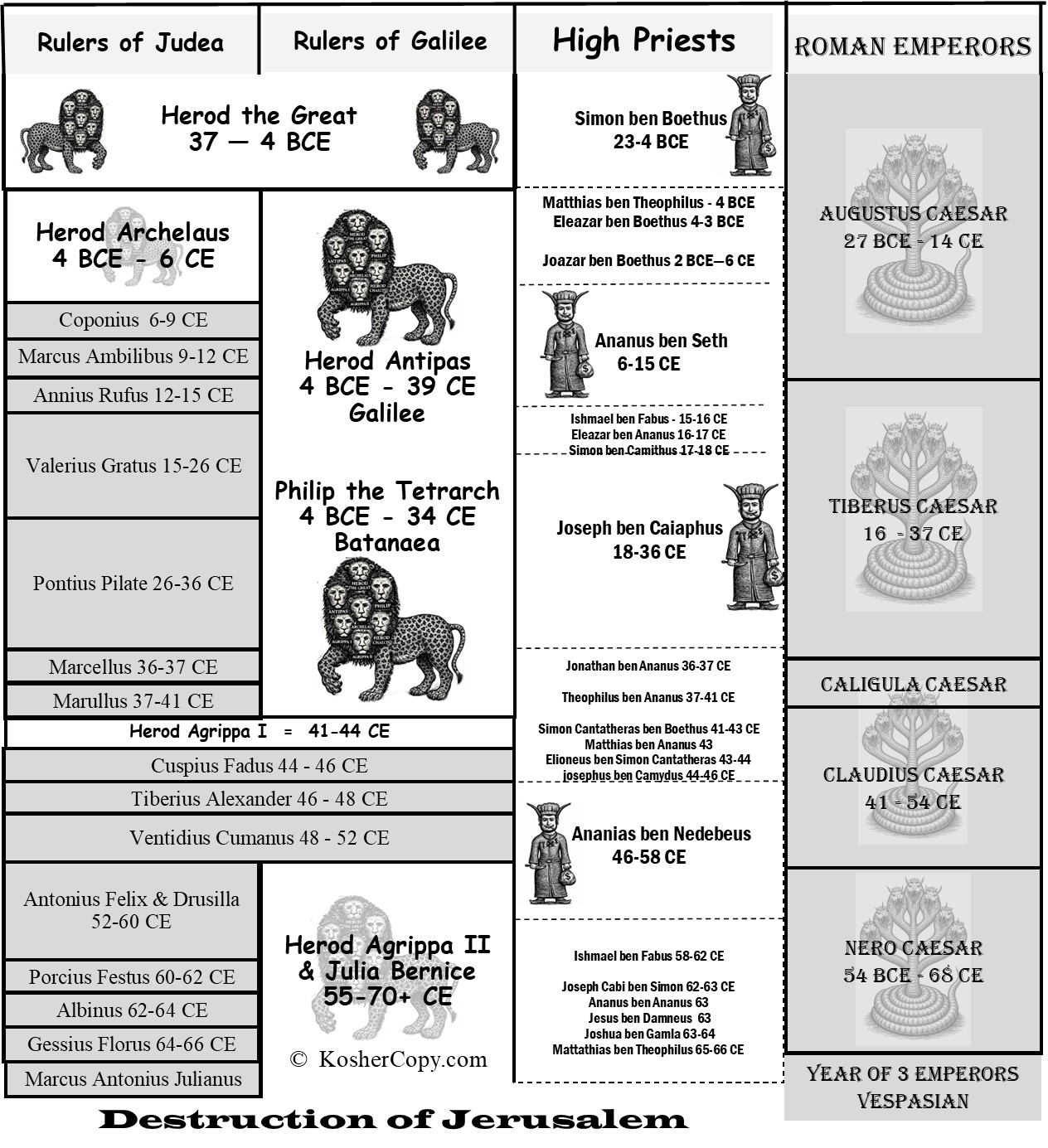
As the adoptive son of Julius Caesar, Augustus claimed to be a descendant of the seven founding kings of Rome. Many of the kings that followed him also claimed to be gods. The list of strong Roman emperors beginning at the time of Jesus’ birth includes: Augustus, Tiberius, Caligula, Claudius and Nero, who have died, the current Caesar, Vespasian, who ruled at the time Jerusalem fell, and the next ruler, Titus, who oversaw Jerusalem’s fall, took the throne after his father’s death, and reigned for ten years.
Who is the eighth Beast?
Domitian, the son of Vespasian and brother of Titus, ruled Rome as the eighth king in the chain of rulers. He served as the religious, military and authoritarian Caesar of Rome for fifteen years. These seven kings represent the seven-headed dragon of Rome. This verse gives a time stamp, as it identifies Vespasian as the man who was serving as Roman emperor at the time Jerusalem fell. The eight kings, who became Roman gods, also stand in marked contrast to the true God of the universe that is the subject of the earlier mirror to this chiasm.
“As for the beast that was and is not, it is an eighth but it belongs to the seven, and it goes to destruction.” As for Domitian, who sits on the throne when John wrote Revelation, and “must remain only a little while” (people were asking, “How long, O Lord.”) was murdered and sent to the grave. History shows that for a few years Rome enjoyed benevolent rulers, but history shows the spirit of the beast. who can inhabit the minds of rulers and people, appeared in succeeding generations and did not die! Nerva, the next Roman Emperor (a former advisor to Vespasian) ruled less than two years; Trajan, the first non-Italian emperor, whose father had commanded Legio X that destroyed the Temple ruled for almost twenty years, and then Hadrian ruled for over twenty years. Hadrian demolished what little remained of Jerusalem and Judea to demoralize the Jews after the Bar Kochba rebellion.
How does the Chiasmus explain this?
Both sides of the chiasm of worship show a major person who joins the one sitting on the throne in unified purpose. On the dark side of the mirror, it is the beast who inhabits the rulers of Rome and Judea. On the light side of the chiasm, God (Rv 4:2-3) and the Lamb with seven horns and seven eyes (Rv 5:6) truly are one. The Lamb and the Lord God are eternal in heaven and work with one purpose on earth. “To him who sits on the throne and to the Lamb be praise and honor and glory and power, for ever and ever!” (Rv 5:13)
Riddle #3: Who are the Ten Horns?
The angel states in Riddle #3, “The ten horns … received royal power… for one hour.” To this statement, the reader should notice, “together with the beast.” These ten “kings” did not rule on their own, but ruled under the authority of the seven-headed Dragon (the Emperor of Rome), (Rv12:3; 17:3; 20:10) at times with the direction of the seven-headed Beast (the Herodian Monarch). These ten are called Roman procurators and legates who governed Judea from the ministry of Jesus (26 CE) until the end of the first Jewish War. The names of the ten men are: Pilate, Marcellus, Manillus, Fadus, Alexander, Cumanus, Felix, Festus, Albinus, Florus.
Riddle #4: Who is the Prostitute?
Riddle number four asks, Who is the Prostitute sitting on many waters? As seen earlier in this chapter, the “many waters,” is a symbol of many peoples, especially the nations around the Great Sea (or Mediterranean Sea). The inhabitants of the world included those from Rome, Spain, France (Gaul), Morocco, Libya, Carthage, Egypt, Israel, Syria, Asia Minor and Turkey. Rome ruled all, which is the “fourth beast-terrifying and frightening and very powerful” in the book of Daniel. (DA 7:7) This beast “crushed and devoured its victims and trampled underfoot whatever was left,” as happened with the Temple and the city of Jerusalem. This also happened to the prostitute, Bernice.
Throughout this passage we can find a literal picture of the harlot in the person of princess Bernice, granddaughter of Herod the Great, and a part of the seven-headed beast as shared in Revelation 13. Agrippa I, grandson of Herod the Great, promised to give his young daughter to an aged Egyptian of great wealth, only to find disappointment because he died before the wedding. (Ant 19.5.1) Her father then arranged her marriage to his brother, Bernice’s older uncle, who was king of Chalcis. (Ant 19.9.1) Bernice, now a queen of Idumean royalty (Dt 31:15; Na 3:3-4) felt stress in her marriage to this father figure until he died.
Was Bernice Really a Queen?
At that point, she inherited her husband’s kingdom and became an equal with her brother Agrippa II as they both ruled much of the Promised Land. (Ac 25:28) As evidenced in the book of Acts, brother and sister lived and ruled from the same palace together. They faced accusations of incest so Bernice married again to a descendant of Mark Antony, but the relationship quickly ended (Ant 20.7.3) and she went back to her brother’s home.
Eventually, (Rv 14) the kingdom ruled by Agrippa II and Bernice rebelled against Roman rule. Emperor Nero sent General Vespasian to quell the uprising. Queen Bernice, always promised in marriage by her father to older men, found this powerful warrior attractive and pursued him. During this time of romantic pursuit, Vespasian attacked and brutally ravaged many rebel hot spots within Bernice’s kingdom of Galilee, where Jews chose martyrdom (suicide) over defeat by a gentile army. Amid this wartime romance, Bernice became enamored by a new and younger warrior, Titus, the son of the general she had pursued.
How did Bernice fall from power?
The woman, who displays all the elements of true wealth, finds herself abused, taken advantage of, and prostituted to her clientele, position, riches, and pursuit of a life of excitement. Because of her wealth, status and position, she finds herself with people, but truly alone. In real life, after the destruction of Jerusalem, Queen Bernice moves to Rome with the promise of marriage to Titus, who follows in his father’s footsteps as the Emperor of Rome. However, the people of Rome despise Queen Bernice and reject her. History, however, does not track her as she exits into a wilderness.
It is the truth: Fact is stranger than fiction!
The book of Revelation did not come out of a vacuum. You can research and find every fact above to be true in the original sources. My book “John’s Apocalypse: A Jewish Idea” gives full details with a multitude of footnotes and first century sources. The book is a great read, and if futuristic interpretations of the Book of Revelation confuse you, the historic timeline presented in “John’s Apocalypse: A Jewish Idea” will help formulate a clear, historic understanding of what John is saying. John did not come to predict the future, he came to explain why such a disaster could happen to God’s people.

