Concocting powerful stories with Abraham Lincoln
Have you ever considered past connections with famous people like Abraham Lincoln?
This content of this question is really Effie Clement’s fault. She is the person who dragged me into the world of genealogy. She simply wanted to know about her family, and asked me, her grand-son-in-law to look into it. She provided pictures, detailed notes, and stories. Grandma Effie also prodded me with questions and for updates.
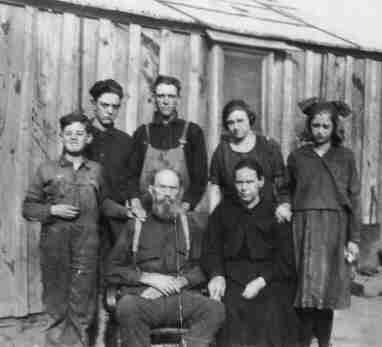
To be specific, Effie desired to know more about her husband’s father who was born in Buffaloville, Indiana, and eventually moved to Neosho, Missouri. I started a search, that eventually ended up in a visit to Buffaloville, where I discovered that Samuel Clement grew up a short distance from the farm where Abraham Lincoln’s father had settled in 1816. But the connection was not casual (it never is in small communities), the two families at one point attended the same church. They were not strangers.
Trails always get strung out
At this point, it should be noted I have an interest in history and had tinkered with a genealogy program on my computer, and so I began down this rabbit trail more than 35 years ago.
The facts were that Samuel David Clement was the sixth or seventh child of Alfred Clements and his second wife Rebecca Bufkin. He was a twin, born in 1849, only a few minutes before or after his twin sister Susannah. This child had twelve or more brothers and sisters, a lot of mouths to feed on the family farm in Spencer County, Indiana.
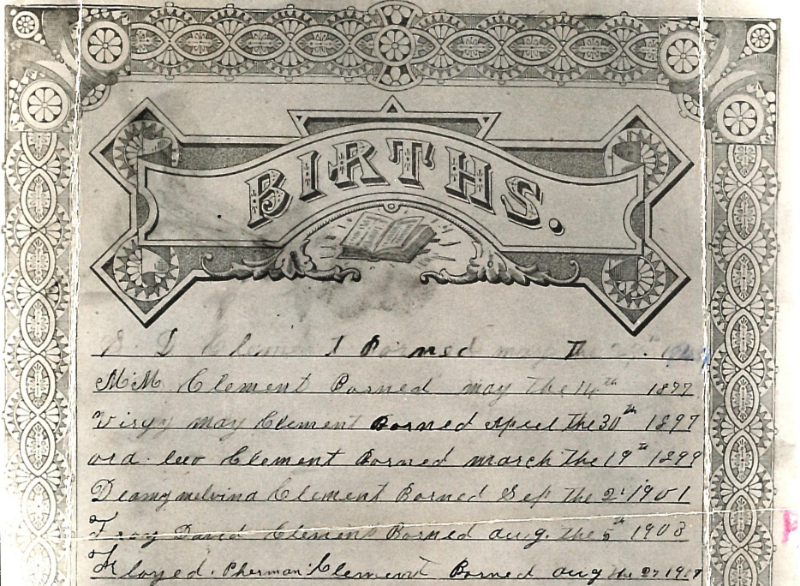
In the process of researching, I looked for information on Family Tree Maker, USGenWeb, RootsWeb, and other local sources. It was there that I discovered the Lincoln family lived in the same area,. But I did not know how far away. I logged the information into a book and put it away to think about at a future time.
Personal visits help dig you in deeper
The future took a couple of years. We had moved east, and one Christmas when my children were young, we decided to drive to Kansas. As I looked on a map to determine the route, I saw a small town and a national historic site at one of the exits along Interstate 64, and decided to visit. The first town, Santa Claus, was just a drive by … but the National Historic Site turned out to be more.
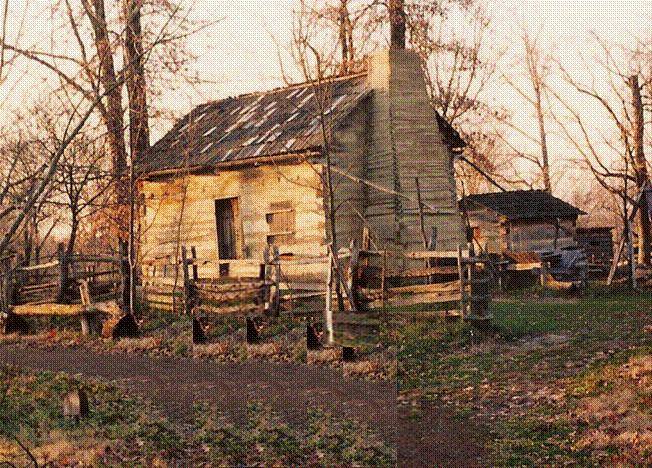
National Historic sites always are more. The problem is our government hires people to work in these places that are always extremely knowledgeable and interested. The park ranger talked about the house (a log cabin) and the community, and the church, Pigeon Creek Missionary Baptist Church, which Thomas Lincoln had helped to start. Then I briefly mentioned, “My wife’s great-grandfather once lived near here.” The park ranger asked for the name, pulled out some papers (they always have papers), and said, “Let’s look at the list of people buried in the cemetery.” (Yes, that is what genealogy is about), and some family was there.
So the stop wasn’t just about a small historic site with its movie, museum and log cabin. It became a visit to the church, the church’s split, and the old home site, all within too short a distance to pass up. We took time for pictures, and left after dark, with four hours to go until our stop in St. Louis.
The tricks minds play
So, I began to wonder, did the family of Alfred Clements know Abraham Lincoln, or his sister Sarah, or Thomas, his father? This was merely speculation. But when I looked it up, it was not so. The Lincoln family lived in the community from 1816, and Abraham moved away in 1830. Samuel Clements was born in 1849 … but … The lawyer, who at that point lived in Springfield, Il, ran for president in 1860, when Samuel was twelve. Did the neighbors know the candidate for President, what did they know, and what did they say? Sometimes the mind runs and just can’t get away.
That’s the problem with genealogy. At first I thought the discipline was like assembling a jig-saw puzzle, just put keep putting pieces in place (or people on the charts) until you are done. Then I discovered the big deception, it is a never ending task. For every piece you put in, two more are generated (the parents of the piece you just found). Some people are satisfied with just names and dates. I always want to know more about the people.
My trips to Virginia
Beyond Alfred and Rebecca Clements, there is always a beyond, I discovered that Samuel and Susannah Clement’s mother was born near Norfolk, Virginia. My parents lived in Hampton Roads. On one my visits, I went to the library, and discovered a land map to the Bufkin farm in Driver, Virginia. Rebecca’s ancestors, who are documented, were roundheads. One of the Bufkin sons left England and came to the colonies in 1635 via Barbados.
Levin Bufkin (born 1634, there are at least five Levin Bufkins, so birthdate helps define them) was a Quaker, and built a church in that George Fox (founder of the Quakers) visited on his tour of America. Levin was also kidnapped by the Algerian pirates in 1678 (this is why I dig deeper), and ransomed about a year later. The line, which merges with the Kings of England goes back to Charlemagne, who was born in 768. (Oy! Why do I torment myself? It is an addiction!)
Abraham Lincoln’s boyhood home
A genealogist never gets bored! There are always more generations to discover, and there are also excuses to travel. A few years ago, when I was visiting my daughter in Cincinnati, we decided to get out and travel on a nice weekend in February. Being the time of Abraham Lincoln’s birthday …
So we went to Hodgenville, Kentucky to see the home where he was born. The house was not as expected, but one comes to expect that in this type of explorations. The log cabin was contained in a temple (Yes, look at the link!). It was so old that the cabin needed to be protected from the elements. And then there is the story, because after Abraham Lincoln became famous an investor bought the house and took it on tour. The display was of interest to people for a while, but after its popularity dropped, the investor stored the disassembled log cabin in a barn.
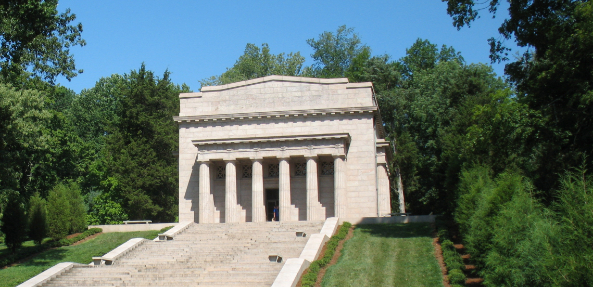
The investor owned a second barn. When he stopped running his expedition, he stored these logs also, but which was which became the question. When Lincoln Farm Association bought the logs and attempted to build reconstruct the birthplace of our nation’s sixteenth President, they discovered there were two (and maybe three) cabins. Some suspect the logs from the birthplace of Abraham Lincoln and Jefferson Davis (born in Fairview, Kentucky, about 125 miles away) are all mixed up. Sometimes that happens in genealogy also.
On the way home, my daughter and I visited Knob Creek Farm, the home where young Lincoln lived from 1811-1816, and Long Run Baptist Church. This church was started by Captain Abraham Lincoln, the grandfather whom the President was named after. The story is that Thomas Lincoln’s father was attacked by when he was a boy. Captain Lincoln ran long and hard, but was murdered by his attackers. Thomas Lincoln built a church at the site in 1844.
The Story’s end
I have probably written more than you want to know about Abraham Lincoln and his family, but it was interesting to me. Of course there is the genealogy from here, and the controversy! I will not write about that.
If you like reading, perhaps you will like my books. The featured book this month is Israel: Stories for your Journey. I have also written a book to be read in the Spring, Passover books, a drama about the Resurrection, and journals that tell the story of the birth of Jesus. Every author needs readers, so I hope you will try one out.