Pentecost: Ascending from Jerusalem to Heaven
. The morning was beautiful. I woke up early at the place of our residence, a hostel near Ben Yehuda in Jerusalem, Israel. My morning walk would take me from the heart of the modern city to the top of the Mount of Olives. Along the way, I would see historic residences, the markets along Sultan Suleiman street, The Damascus Gate, Herod’s Gate, Golgotha, The Rockefeller Museum, several Cemeteries, Lion’s Gate, the tomb of Mary, Pater Nostra and the Chapel of the Resurrection. The morning air was wonderful and the sights were fantastic.

Walking along HaNevi’im Street
. I began my walk on HaNevi’im Street, or the street of the Prophets. I passed many residences from the British era and some churches. Many places begged for me to look at them and read their historic markers. Although not inside the walled city, there are many historic sites from the last century that are worth seeing. The history of north and east Jerusalem are worth learning about so the seeds of today’s troubles can be better understood. These residences speak about a a season of history, not so long ago, when people lived in relative peace and had time to enjoy a slower life.

. As HaNevi’im Street nears the walls of Jerusalem and crosses several former armistice (Green) lines, the landscape opens up at Sha’ar Shrkhem Square and my route takes me along Sultan Suleiman Street. The Damascus Gate stands near the point where my route takes a turn to continue east. The Damascus gate is the main entrance into the walled city of Jerusalem from the north. The current gate is about 500 years old, and was constructed by Suleiman the Magnificent, the tenth and longest-reigning Sultan of the Ottoman Empire. He reigned from 1520 to 1566. A bit about his wall building can be found in an earlier blog.

The Damascus Gate
. The Damascus Gate itself, is built on top of an earlier gate. In 2012, this gate escaped my attention. But as I wrote Israel: Stories for Your Journey, I came to know more about the gate below the Damascus Gate. This gate is from the time of King Agrippa II, when the northern, third wall of Jerusalem was built. The wall was destroyed in the time of Hadrian, but the arch of the gate remained, and a victory plaza was built just inside the gate. In the picture, you can see this Hadrian era gate below today’s Damascus Gate.
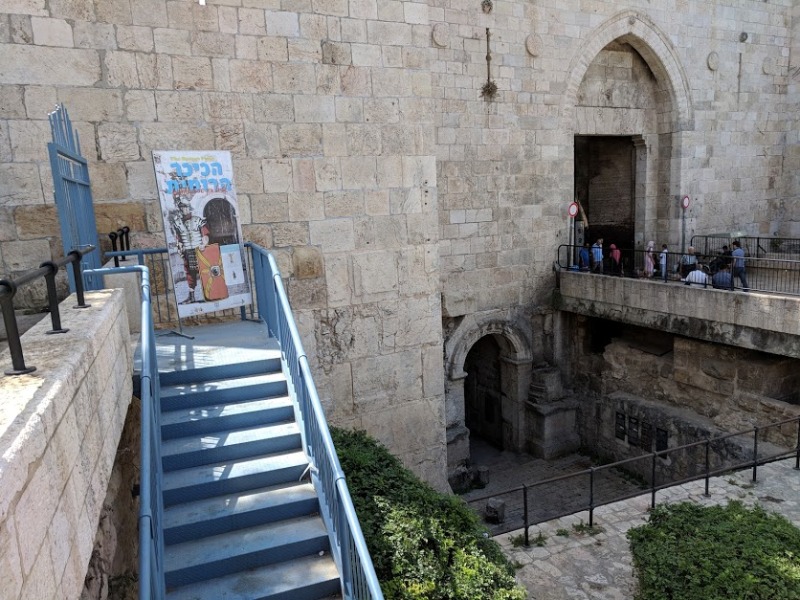
. The Damascus Gate brings travelers from the north (which is why it is called Damascus Gate) onto the main road that leads south through the heart (Cardio) of Jerusalem. There were many markets along this avenue that would be visited by tourists, pilgrims, travelers, and residents alike.

. As I continued along Sultan Suleiman Street, I passed a stone quarry (Zechariah’s Cave), the cit bus terminal, and Herod’s or Flowers Gate. Golgotha sits behind the bs terminal with an Arab cemetery sitting above the cliff face. Some believe this is the place where Jesus was crucified. The ridge on which Jerusalem sits continues to rise in elevation beyond Al-Sahira Cemetery to the north.
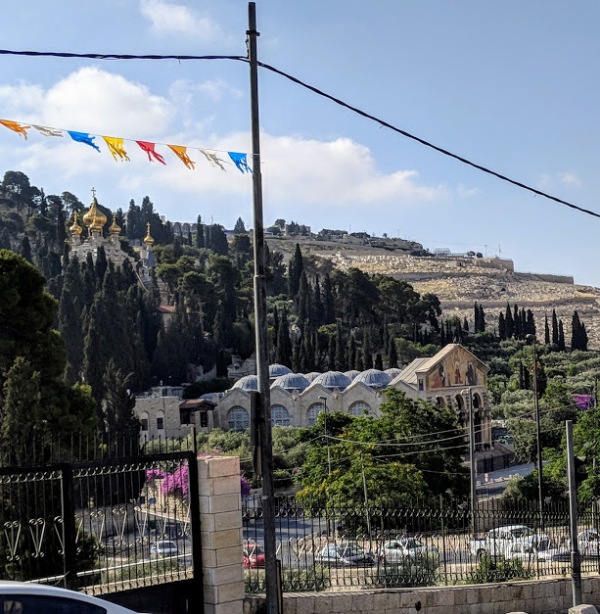
. Near the Rockefeller Museum (worth seeing) I turned south. I walked through an Arab cemetery that sits along the wall of Jerusalem. The path leads near the Stephen or Lion’s Gate. This gate was near the Sheep Gate of the first century BCE – CE. The Lion’s Gate is the only portal currently leading out from the walled city of Jerusalem. During the days of the Temple there was also an Eastern Gate from Temple Mount that led to a causeway up the Mount of Olives. The gate, now called the Golden Gate, is closed.
Climbing the Mount of Olives
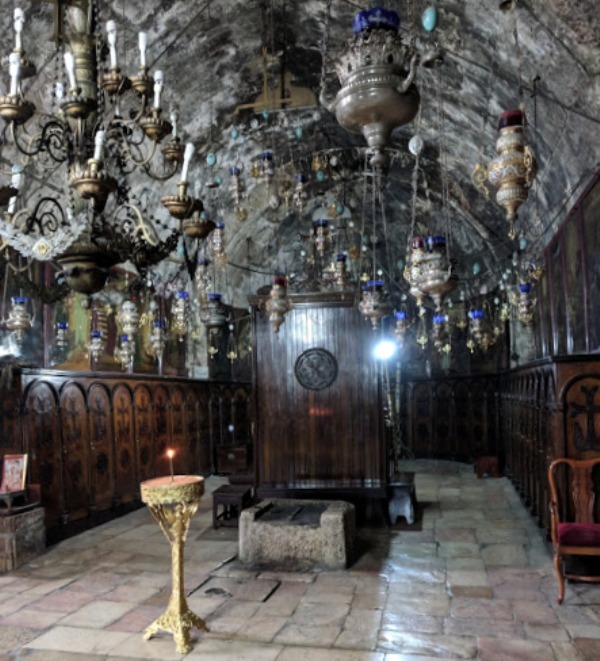
. There are many caves in the limestone setting of Jerusalem. One of them just outside the city, in the Kidron Valley, at the foot of Mount Moriah and the Mount of Olives is known as the tomb of the Virgin Mary. There is a place of prayer at this site, and a very ornate chapel in which the burial site of the Virgin Mary is contained. This site is part of Gethsemane, across the road from the church of All Nations. If you climb the Mount of Olives, this site is worth visiting.
There are two roads and a set of steps up the Mount of Olives. I took the steps. I think there are about 600 steps, with views of Jerusalem, trails, and houses. There are no cars, and the steps are more level than the road. I thought about King David and Jesus, who climbed this mountain at different points of history. The road leads to the top of the mountain. On the top of the mountain I visited Pater Noster, the place Jesus prayed in the Garden, and the Chapel of the Ascension. It is believed that Hulda the Prophetess was buried there.

. Jerusalem is a beautiful place to visit, and is normally very safe. During these current days of stress, pray for the peace of Jerusalem. If you go, please take my book with you.