Pergamon in the First Century
John begins the book of Revelation with letters to seven churches: Ephesus, Smyrna, Pergamum, Thyatira, Sardis, Philadelphia, and Laodicea. Various people give different meanings to these seven congregations. William Barclay, in his commentary, focuses on the history of each city. George Eldon Ladd in his commentary focuses on the phrases in the text.Robert Mounce in his commentary pulls out significant details from every portion of each verse. Mitchell Reddish provides an extensive overview of what is happening in each town. Henry Ironside’s Lectures on the Book of Revelation looks at each city through the lens of a dispensational time period.
In this blog, I will seek to give a brief history of each town, focusing around the time period when John wrote the book of Revelation. Second, I will survey the current environment of the city and the church featured within that city. Finally, I will examine how John connects each assembly to a specific Jewish festival and what this means.

A Jewish look at the Book of Revelation
The first-century Jewish connections that John includes within the text of the book of Revelation are fascinating, and often completely overlooked by Gentile writers. The inclusion of John’s words and thought patterns bring clarity to the text, help to locate the book in its proper cultural setting, draw readers of my commentary into the late first century environment that necessitated caused John’s writing of the Apocalypse, and open a new window into a proper interpretation of the book. For some writers, Revelation is a guide to the future; for other writers, the Apocalypse is a reaction to Roman rule; academic writers parse the text critically. For me, the study of Revelation opens a window to look at John’s Apocalypse through the eyes of a first-century Jewish survivor of the destruction of Jerusalem.
All of these elements are included in my series of the Seven Assemblies on the Book of Revelation. The first article (here) gives an introduction to the Seven Churches of Revelation. The second article (here) explains the leadership of churches in the first century. A third blog (here) examines the character of the seven churches. Above, you will find links to the seven articles on the churches. I have included pictures I took while visiting the seven cities of Asia Minor within the text of these blogs.
To fully understand the book of Revelation from a first-century perspective, you should purchase the book (actual book; electronic book, or audio book, or buy it at your local book store) and read it in its entirety. A sample is below:

The Mountaintop Town of Pergamos
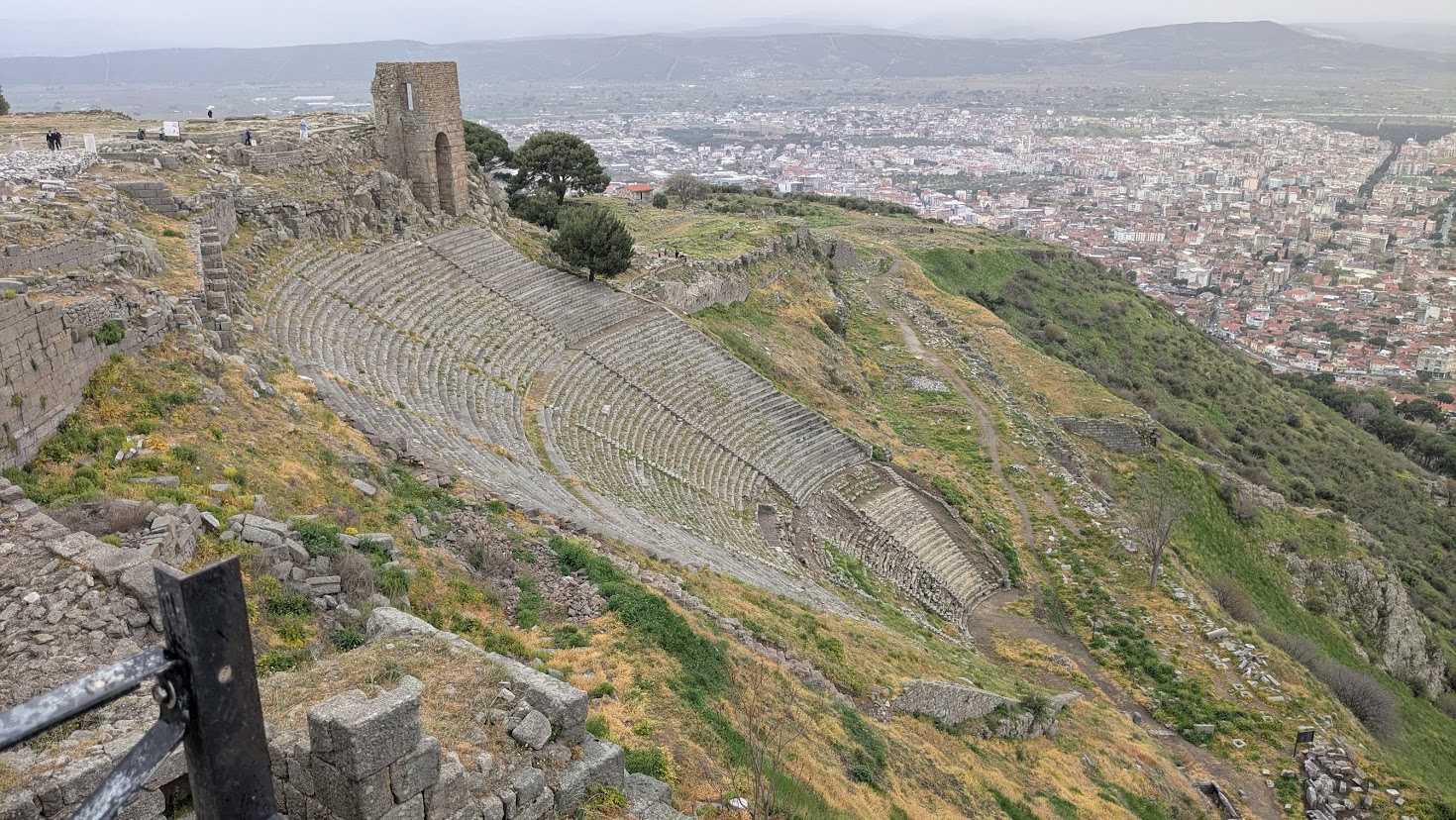
The mountaintop town of Pergamum (or Pergamos) was the most intellectual of the seven cities in this section of Revelation. King Eumenes II (197-159 BCE), a powerful king who ruled this city, loved literature and assembled the second largest collection of books in the world. Many parchments, or scrolls written on un-tanned animal skins, were part of the library’s collection. He led his citizens to love the arts, to develop beautiful temples, and to build expansive medical facilities.
After Eumenes II died, the kingdom of Pergamum passed to his son Attalus II (159-138 BCE), and then to his nephew, Attalus III (138-133 BCE), who died without an heir. Through long-standing alliances, the kingdom was to peacefully become a Roman province. However, Mithridates VI, king of Pontus, and some unhappy civic leaders of Pergamum forcefully objected and raised an army to take control of the fortress. Rome destroyed the rebellion as if it were using a sharp, double-edged sword to punish the rebels. Mark Antony of Rome gave the impressive library to Cleopatra, who removed the books to Alexandria, and Governor Flaccus robbed the synagogue offerings in order to reimburse Rome.
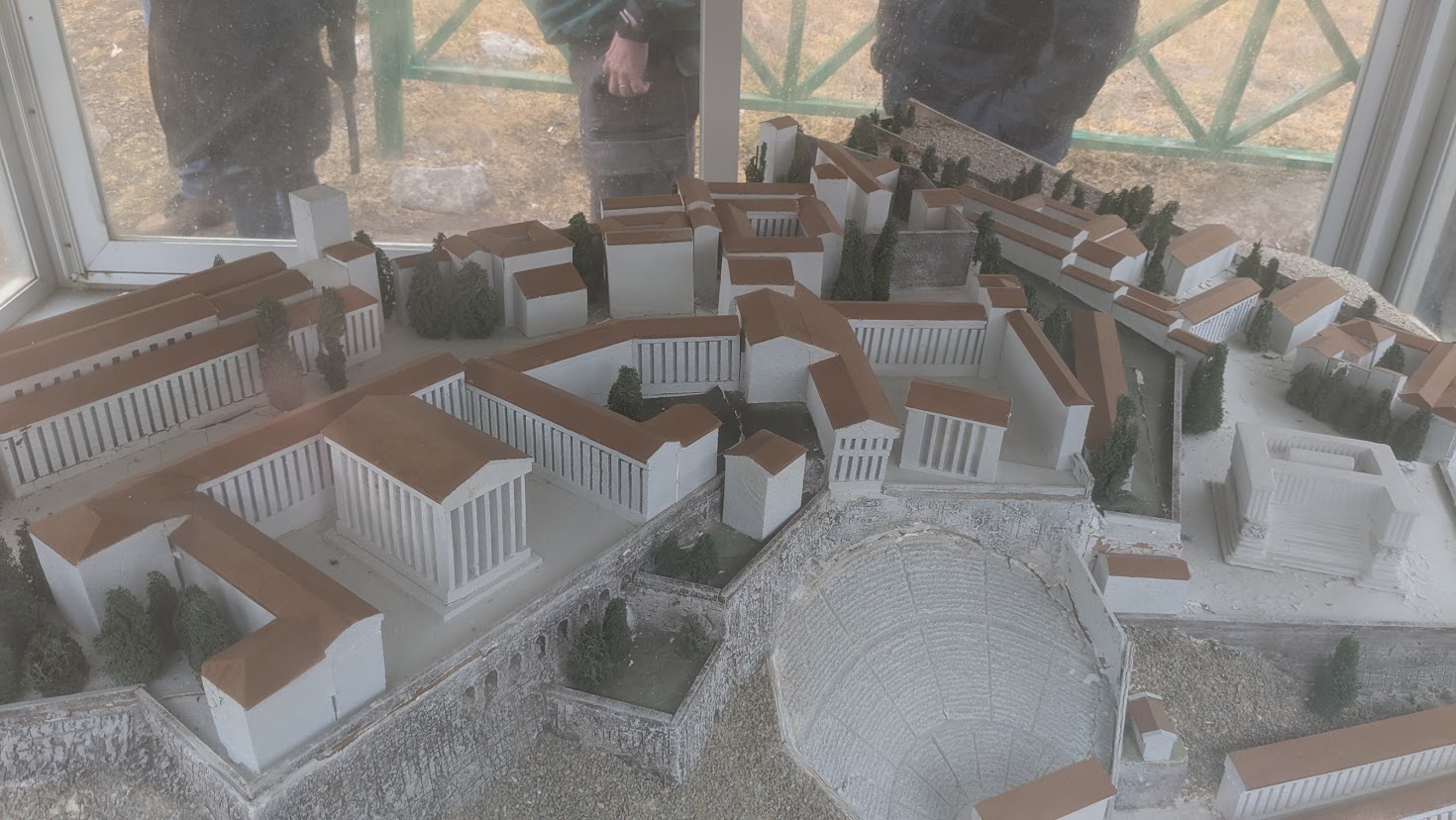
Herod the Great, who was an ally of Mithridates and a friend of Rome, assisted the city by rebuilding some of the decaying buildings. Five magnificent temples, to Athena, Zeus, Dionysus, Caesar Augustus and Asclepius, renewed the energy of the former capital and drew many visitors. A great hospital connected to a physician named Asclepius became famous and treated people from around the world.
The Christian Congregation at Pergamos
The church in Pergamum must have been small because there are no written or archaeological records of either a Christian or Jewish community. The Apostolic Constitutions record Gaius, to whom John wrote his third epistle, was pastor of the Pergamon congregation.
The Jewish feast of Sukkot
The letter to the church at Pergamum is full of references to the Feast of Tabernacles. This feast, also called Sukkot, commemorates Israel’s forty years of wandering in the wilderness following the Exodus from Egypt. During their journey, the people of Israel regularly disappointed God and angered Moses. It was as if Satan lived in this wilderness.
Israel faced confrontations from within and from outside its population. The Amalekites who struck on the eve Moses was to ascend Mt. Sinai to meet God, initiated the first and most noted attack. This is the pattern of the evil nation that stands in the way of God’s plan. Israel also faced a challenge from Balaam who came at the bidding of Moabite King Balak. Although God kept Balaam from cursing Israel, some fell to sexual sin with Moabite women.
An internal challenge called Korah’s Rebellion provided the example John used to explain the Nicolaitans. This title is a combination of the words: to conquer (nikos), and people (laos). Early churches at Ephesus and Pergamum were facing internal strife.
During the forty years of wandering in the wilderness, God fed the people manna every morning (except on the Sabbath). God promises to give hidden manna to those who remain strong in faith during the times of trial. Jesus said, “This is the bread that came down from heaven. Your forefathers ate manna and died, but he who feeds on this bread will live forever.” The one who follows Jesus will receive a white stone, which signifies “Yes!” The white stone is part of the Urim and the Thummim the High Priest carried in his breast piece to make decisions. This practice started in the wilderness, and the Mishnah explains it. They will get a new name bestowed by the Lord Himself.

To read more about the Seven Churches and to learn more about what John was saying to early believers in Jesus, purchase the book “John’s Apocalypse: A Jewish Idea.” (actual book; electronic book, or audio book, or have your library order a copy so you and others can read it!) so you can see the the Apocalypse as others understood the book at its initial release.